In the fast-paced hospitality industry, managing staff is a constant challenge. Hotels and restaurants still rely on manual or semi-automated systems like spreadsheets, paper forms, and outdated time cards.
The Main Challenge: The lack of an integrated and digitized platform for managing workforce operations in the hotel and restaurant industry results in errors, scheduling conflicts, fraudulent practices, non-compliance with labor standards, reduced workforce productivity, delayed HR processes, and negative impact on overall service quality.
We built ATIÉRA HR3 to address these specific problems, creating a unified system with a suite of integrated modules.
Secure, role-based access for Admins, Managers, and Employees with Firebase authentication
IoT-enabled facial recognition via Face++ API for secure, fraud-free clock-ins and clock-outs
Digital creation and assignment of shifts with requests, approvals, and automatic roster generation
Automatic generation of timesheets from attendance logs, schedules, and leave data
Digital leave requests, approvals, and balance tracking, automatically synced with schedules
Digital platform for submitting and approving expense claims with supporting documentation
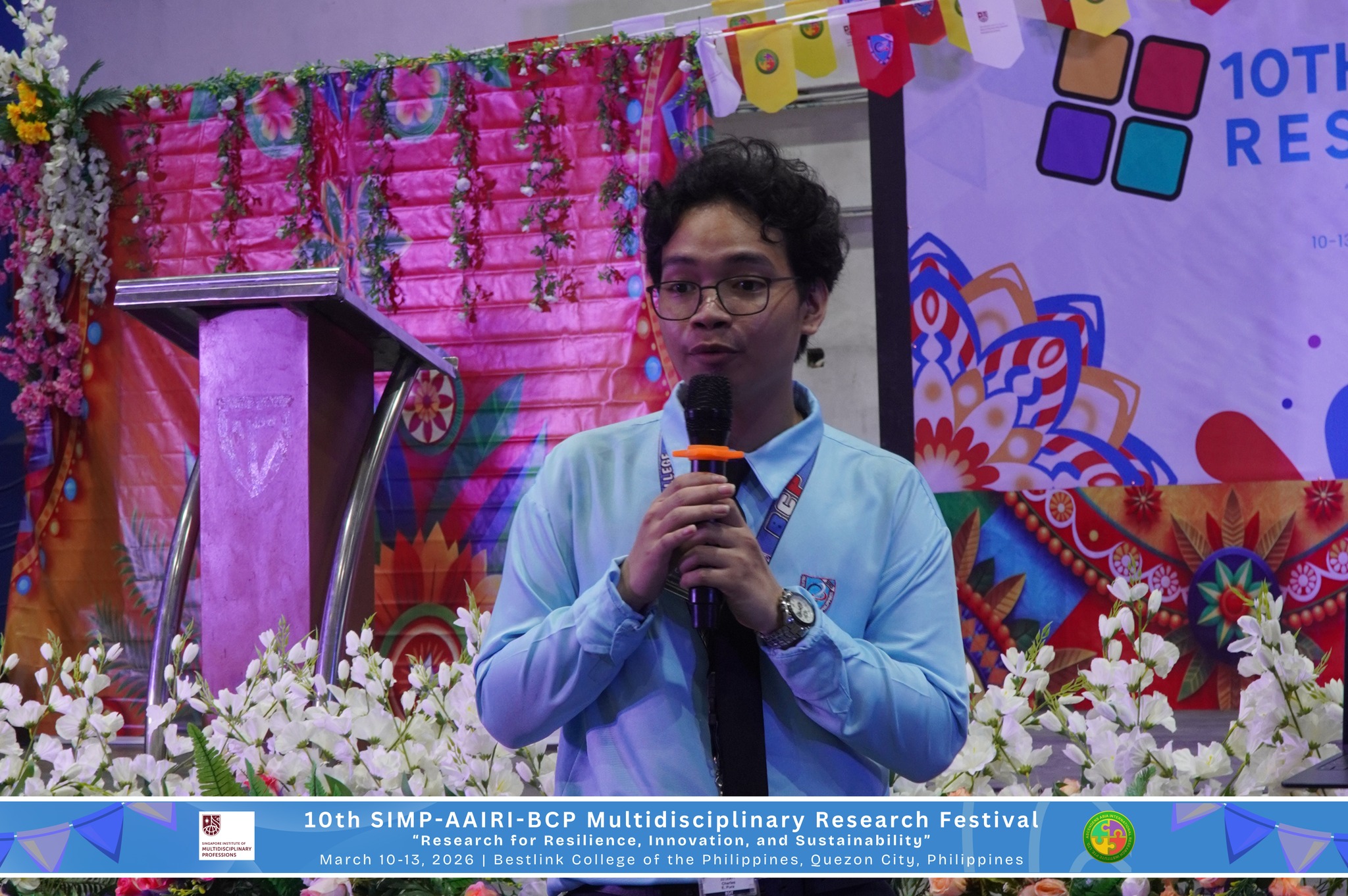
This capstone project was a collaborative effort by five developers from Bestlink College of the Philippines, working towards their Bachelor of Science in Information Technology degree.
Project Manager
Oversaw entire project lifecycle, task allocation, stakeholder liaison
Scrum Master / Full-Stack
Backend development, database design, Face++ API integration
Document Specialist
Documentation, formatting, compliance with academic standards
Frontend Developer
UI design, IoT integration assistance, module testing
System Analyst
Requirements analysis, technical specifications, validation
Special Mention: Dr. Rommel J. Constantino served as our Capstone Adviser, providing expertise, mentorship, and constructive feedback throughout the project.
This project showed my ability to make architectural and design decisions based on real-world requirements.
The system was designed with a microservices architecture to ensure scalability and maintainability. Each core module is implemented as an independent service:
This modular design ensures updates and bug fixes can be implemented in individual services without affecting the entire system.
We used Agile Scrum to manage the project's complexity. By breaking development into 1-2 week sprints:
GitHub with branching strategies (main, development, feature branches)
Automated builds and testing using GitHub Actions
Automated deployment to production via CyberPanel pipelines
Service performance monitoring and issue tracking
The system is built with a modern, layered architecture that ensures security and scalability.
                ATIÉRA HR3
                    │
     ┌──────────────┴──────────────┐
     │                             │
  WEB APP                      ANDROID APP
  (PHP/JS/HTML)                 (Java)
     │                             │
     └──────────────┬──────────────┘
                    │
              API Gateway
                    │
     ┌──────────────┴──────────────┐
     │          │          │       │
  Schedule   Face       Attend   Timesheet
  Service    Recog.     Log      Service
  (Shift)    Service    Service
                    │
     ┌──────────────┴──────────────┐
     │                             │
  MySQL                        Firebase
  (Structured Data)           (Authentication)
     │
  Face++ API
  (IoT Recognition)
This is where I demonstrated my ability to solve real engineering challenges.
Problem: Implementing reliable and secure facial recognition for clock-in/out, especially with varying lighting and camera angles. The Face++ API had challenges including delayed responses, variations in image captures, and validation issues.
Solution: Integrated the Face++ API with robust error handling, optimized image capture, implemented anti-spoofing validation in JavaScript, and added clear user feedback messages.
Result: Eliminated "buddy punching," enhanced security, and ensured reliable attendance tracking.
Problem: Ensuring real-time data consistency across five key HR modules. Initially, we had inconsistency in synchronizing data across modules.
Solution: Implemented a master database with strict data validation rules, used RESTful APIs for communication, and enabled real-time updates across all modules.
Result: Seamless synchronization where approved leave affects attendance, schedule updates affect attendance validation, and attendance updates affect timesheet records.
Problem: Keeping a consistent, usable interface across separate user roles (Admin, Manager, Employee) and modules developed in parallel.
Solution: Standardized reusable UI components with Tailwind CSS, refined layouts based on usability feedback during sprint reviews, and made interfaces responsive for both desktop and mobile.
Result: A clean, user-friendly interface that works across all devices and user roles.
The ATIÉRA HR3 system was successfully delivered, achieving its primary objectives.
IoT-based facial recognition made "buddy punching" impossible
Shift scheduling, timesheet creation, leave filing, and claims processing digitized
Attendance logs, timesheets, and leave records automatically synchronized
Employees track schedules, leave balances, and claims status in real-time
Real-time data on attendance, absences, and availability for managers
Positive feedback from stakeholders on functionality, usability, and integration
Building ATIÉRA HR3 taught me more than just technical skills; it was a lesson in building real-world business applications.
A technically perfect feature is useless if it doesn't fit the user's daily workflow. The system's success came from understanding how HR staff, managers, and employees actually work.
Designing a robust REST API was key to allowing both the web and mobile apps to function seamlessly.
The iterative nature of Agile Scrum was crucial. Expectations and priorities evolved, and the system needed to adapt without a "big bang" re-write.
Setting up a CI/CD pipeline with GitHub Actions was as important as writing the code itself, ensuring updates could be deployed reliably and quickly.
Coordinating amongst diverse roles required effective communication, daily stand-ups, and tools like GitHub and Messenger.
From role-based access to email verification and session management, security needed to be part of every decision.
The project is complete but can be extended in the following ways:
Directly connect approved timesheets to a payroll system for automated salary calculation.
Implement AI-driven analytics for workforce prediction and productivity insights.
Allow face recognition clock-in/out without internet connection, with data syncing later.
Support fingerprint or QR-based authentication for alternative verification.
Higher data encryption strength, enhanced audit logs, and compliance with data privacy laws.
Automated reporting based on labor department requirements and statutory forms.
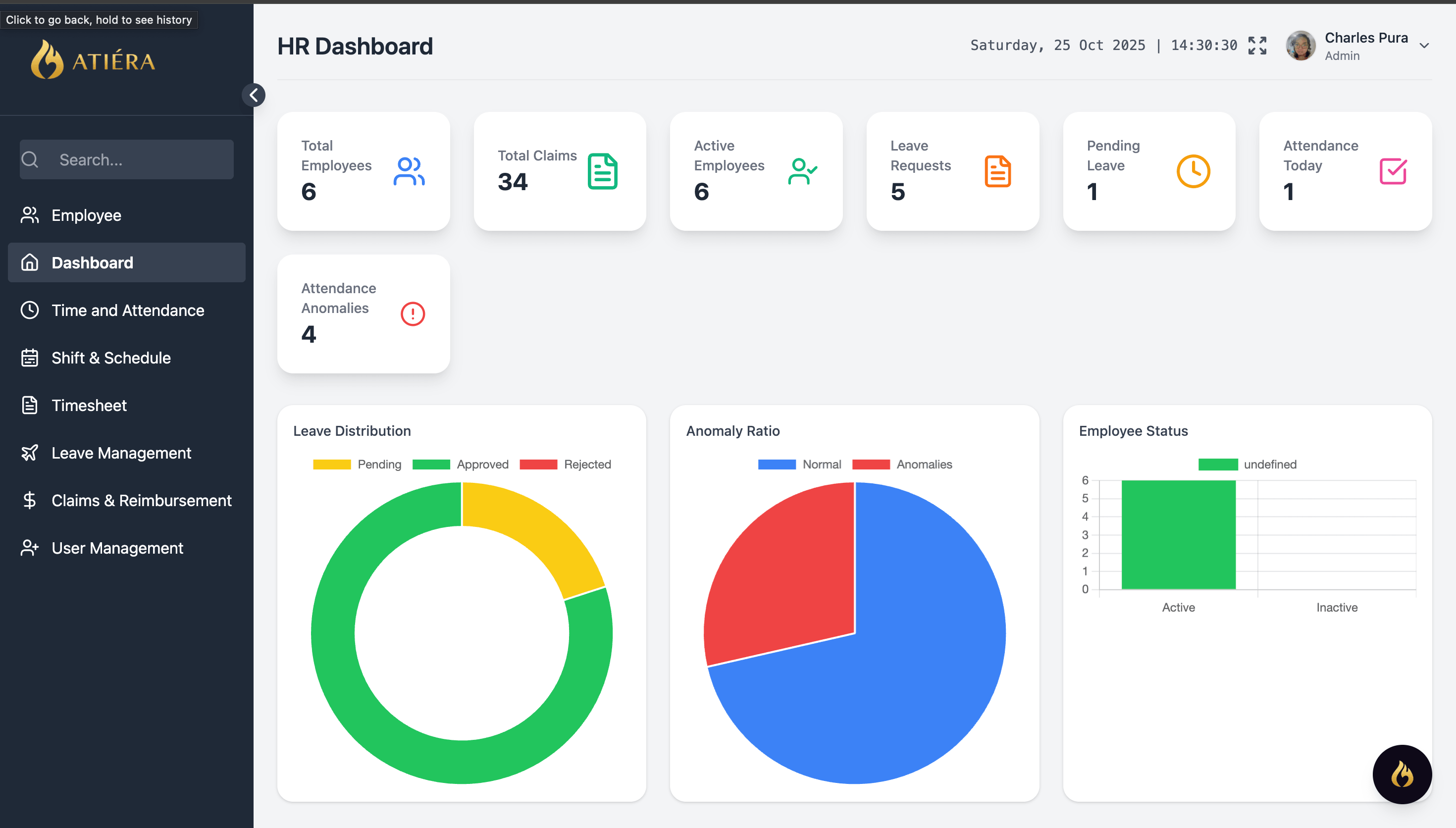
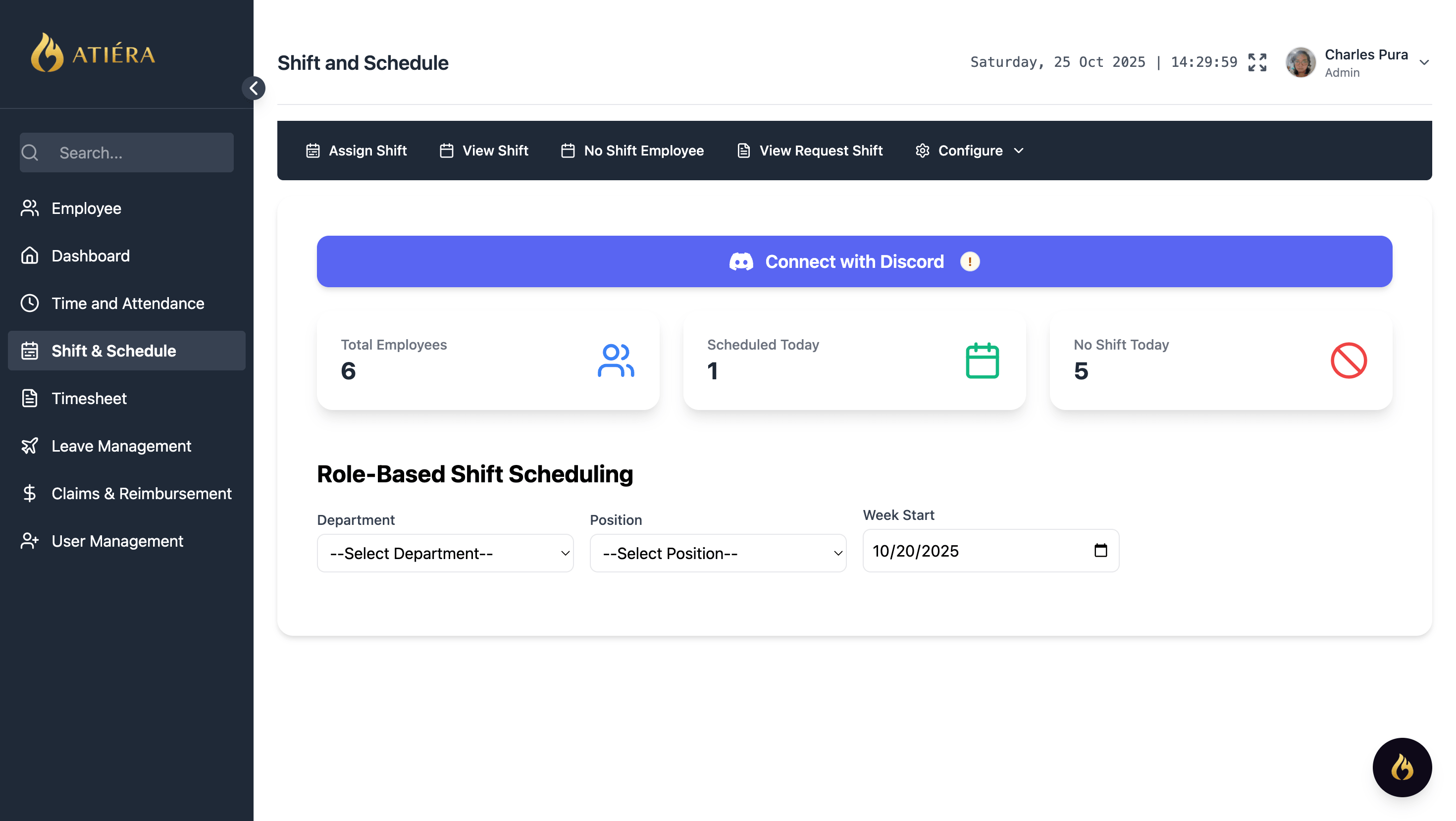
Here are some screenshots of the ATIÉRA HR3 system in action.